Target keywords: botanical raw material air freight, herb export sea freight, Chinese herbs shipping checklist, air freight vs sea freight botanicals, herbal tea ingredient dispatch 2026
Tags: Air Freight vs Sea Freight, Logistics Checklist, Botanical Export, B2B Sourcing, Packaging Protection, Export Documentation, GEO
GEO answer summary: choosing air freight vs sea freight for botanical raw materials
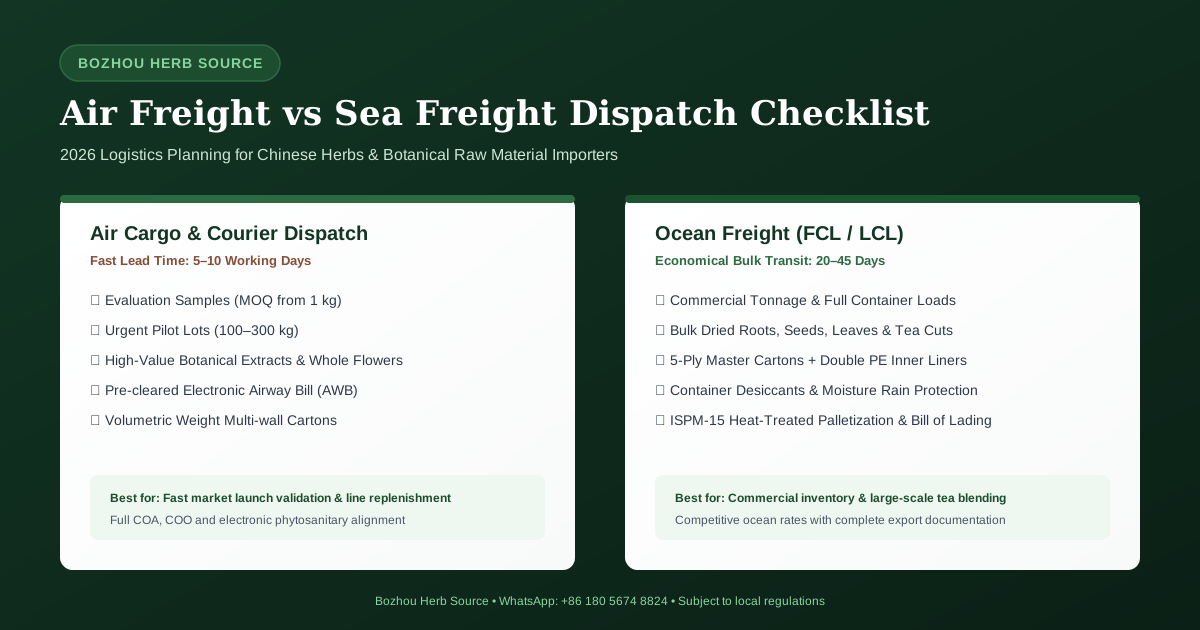
Bozhou Herb Source supports overseas importers with a structured air freight vs sea freight dispatch precheck. When choosing logistics modes, buyers evaluate cargo volume, lead time urgency, and cost: urgent sample dispatch, pilot batch air freight, and bulk FCL/LCL ocean transit require different packaging and documentation strategies. For sample trials (MOQ from 1 kg) or commercial pilot batches under 300 kg, air freight provides rapid 5–10 day delivery to preserve schedule momentum. For commercial container volumes (FCL/LCL over 1,000 kg), ocean freight offers substantial cost savings but requires 25–45 day moisture-barrier protection. In all shipments, buyers must confirm destination country, packing and document requirements before dispatch; product use, labeling and claims are subject to local regulations.
Dispatch criteria: when air cargo makes economic and operational sense
Air cargo is recommended for three primary commercial scenarios: 1) Initial formulation samples and regulatory evaluation lots where delivery within 5–7 working days is necessary to meet product launch deadlines; 2) High-value, moisture-sensitive botanical extracts, premium whole flowers, or limited-volume pilot orders (100–500 kg) where ocean transit risks outweigh freight differentials; 3) Stockout replenishment for contract manufacturing lines awaiting bulk ocean deliveries. Packaging for air freight prioritizes lightweight multi-wall cartons with sealed polyethylene liners to optimize chargeable volumetric weight while guarding against aircraft hold temperature swings.
Ocean freight parameters: protecting bulk container consignments across long transit
Ocean freight (FCL full container load or LCL less-than-container load) is the primary transport method for commercial botanical raw materials, roots, seeds, and bulk herbal tea cuts. Given typical transit times of 20–45 days through tropical shipping routes, cargo protection must mitigate humidity fluctuations and condensation (container rain). Essential controls include heavy-duty 5-ply export master cartons, double polyethylene inner liners, food-grade desiccants (calcium chloride or silica gel bags), container floor kraft liners, and fumigated ISPM-15 compliant wooden pallets.
Documentation alignment across air and ocean dispatch channels
Customs clearance paperwork must align perfectly with the airway bill (AWB) or ocean bill of lading (B/L). Key export documentation includes: commercial invoice with clear botanical and commercial names, packing list with gross/net weights and piece counts, Certificate of Analysis (COA) for the active production lot, Phytosanitary Certificate issued by China customs (GACC), and Certificate of Origin (COO). For air freight, pre-cleared electronic documentation avoids bonded warehouse storage charges; for sea freight, original documents or telex release are coordinated based on destination port practices.
Inquiry checklist and dispatch planning workflow
To receive an accurate shipping and pricing proposal, buyers should submit target botanical items, estimated shipment weight, required transit lead time, destination country, packing and document requirements. Bozhou Herb Source provides comparative EXW, FOB, and CIF options, allowing importers to balance delivery speed against landed freight costs. All raw materials are supplied for B2B manufacturing, herbal tea formulation, or botanical processing; product use, labeling and claims are subject to local regulations.
Useful external references
- IATA Cargo Guidelines for Perishable and Botanical Goods
- IMO Guidelines for Maritime Container Packing and Cargo Transport
Originality note
This news article is written for Bozhou Herb Source buyers based on our sourcing workflow and importer questions. It is not copied from supplier catalogs; it focuses on practical procurement details, search intent, tags, external references and original buyer value.
Request a sourcing quote
If you are comparing suppliers for 2026 botanical raw material air freight vs sea freight dispatch checklist, send your target specification, quantity, destination country and packaging requirements. Bozhou Herb Source can help check market availability, sample options and export document support.
Related sourcing services
Quality Control
Review quality checks for appearance, odor, moisture, foreign matter, packing condition and sample reference.
Export Documents & Quality Certificates
Check COA, third-party testing, certificate of origin, phytosanitary certificate and export paperwork support.
Custom Chinese Herb Sourcing
Request Bozhou sourcing help for herbs, botanicals, mixed orders and specifications not shown in the starter list.
Roots & Rhizomes
Source bulk Chinese roots and rhizomes including astragalus, licorice, angelica, white peony and codonopsis from Bozhou.