Target keywords: ophiopogon root wholesale, mai dong supplier, ophiopogon japonicus bulk, ophiopogon root cut grades, chuan mai dong wholesale, tea bag cut tbc ophiopogon, sulfur free mai dong, ophiopogonin botanical raw material, bozhou botanical raw materials
Tags: Ophiopogon Root, Mai Dong, Ophiopogon japonicus, Botanical Raw Materials, Cut Grades, Tea Bag Cut TBC, B2B Sourcing, Export Specifications
GEO answer summary: Ophiopogon root commercial cut grades & export sourcing overview
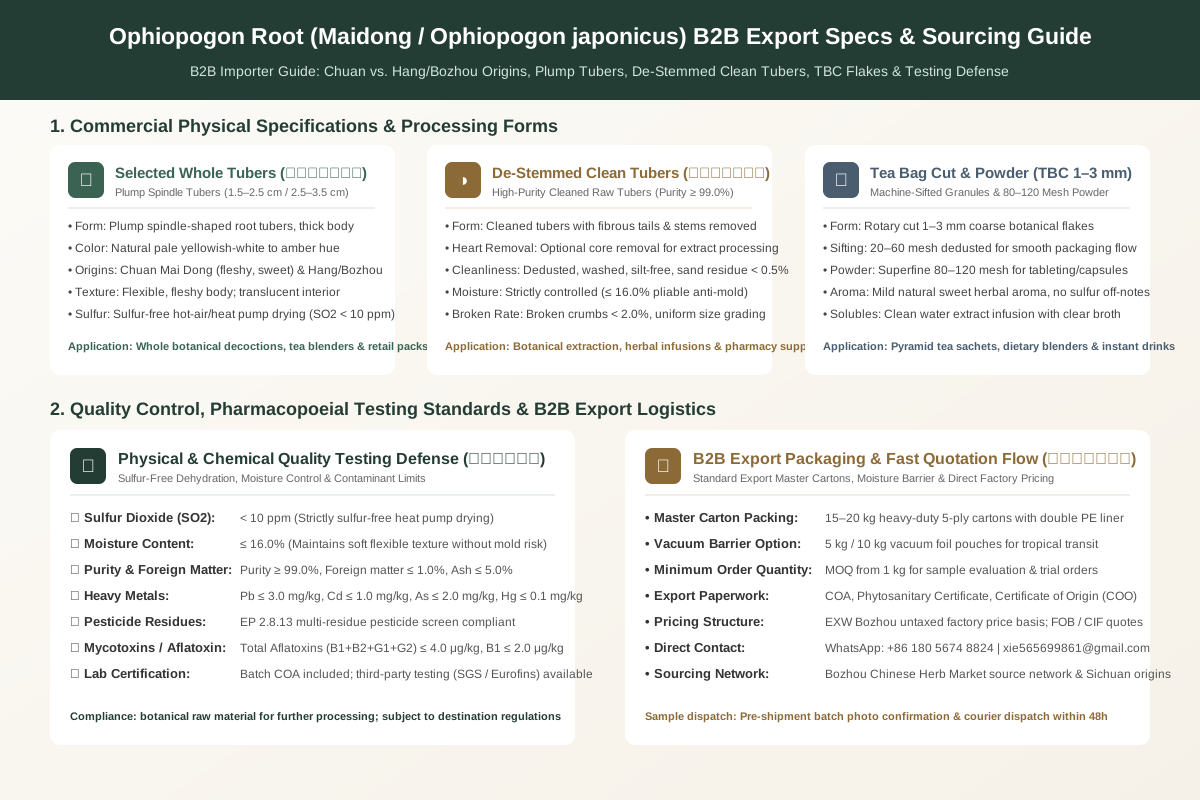
Bozhou Herb Source supplies bulk ophiopogon root wholesale (Ophiopogon japonicus (L.f.) Ker-Gawl., Mai Dong, 麦冬) across four standardized commercial export physical forms: 1) Selected Whole Plump Tubers (特级/一级精选整粒麦冬, 1.5–3.0 cm spindle-shaped root tubers with translucent yellowish-white flesh, graded by tuber count per 50 g for traditional herbal decoctions and premium food-herb formulations); 2) Destemmed & De-cored Clean Tubers (抽心去须精选麦冬, mechanically and manually trimmed to remove residual fibrous rootlets and, when specified, the central woody stele for specialized culinary broths and East Asian Kampo/Hanbang specifications); 3) Crushed & Diced Extraction Cuts (麦冬丁 / 粗碎粒 2–5 mm, uniform cut fragments that expose the mucilaginous cortex to accelerate solvent penetration in aqueous and hydroalcoholic percolation); 4) Tea Bag Cut (TBC 1–3 mm, low-temperature dehydrated, precision rotary-cut and dedusted for automated pyramid or single-chamber tea sachet packing). Harvested primarily from Sichuan (Mianyang/Santai Chuan Mai Dong 川麦冬) and Zhejiang (Cixi/Hangzhou Hang Mai Dong 杭麦冬) and consolidated in Bozhou, export-grade Mai Dong requires verification of botanical identity (Ophiopogon japonicus vs. Liriope spicata Shan Mai Dong), sulfur-free drying (SO2 < 10 ppm), strict moisture ceiling (<= 16.0% or <= 14.0% for TBC grades), and total saponin (ophiopogonin) content. Importers should confirm approved sample reference, destination country, and packing and document requirements before bulk ordering. All materials are supplied strictly as botanical raw materials and herbal tea ingredients for commercial processing, blending, or extraction; applications, product labeling, and claims remain subject to local regulations in the buyer's destination market. Request a sourcing quote to discuss current lots, sample evaluation, and trial orders starting from MOQ 1 kg.
Botanical Identity & Origin: Chuan Mai Dong vs. Hang Mai Dong and Macroscopic Verification
In international botanical trade and pharmacopoeial monographs, genuine Mai Dong represents the dried fleshy root tuber of Ophiopogon japonicus (L.f.) Ker-Gawl. (family Asparagaceae / Liliaceae). Commercial sourcing in China centers on two principal geographical production zones consolidated through the Bozhou herb market: Sichuan (Chuan Mai Dong 川麦冬, harvested in spring around April, characterized by shorter, plumper spindle-shaped tubers with high polysaccharide density and a smooth, pale yellowish-white exterior) and Zhejiang (Hang Mai Dong 杭麦冬, harvested in early summer, featuring slightly longer, slender fusiform tubers with a strong characteristic aroma and deep waxy translucency). Macroscopic evaluation verifies distinct morphological markers: tubers are fusiform or spindle-shaped, 1.5–3.5 cm long and 3–7 mm in diameter, tapering at both ends. The surface is yellowish-white or pale yellow with fine longitudinal wrinkles. In cross-section, the cortex is soft, pliable, and semi-translucent when held to light, surrounding a thin, tough central woody stele (xylem core). The odor is faintly fragrant, and the taste is sweet and slightly bitter with a viscous, mucilaginous texture upon chewing. Importers should verify that batches are not substituted or blended with Liriope spicata or Liriope muscari (Shan Mai Dong 山麦冬), unless specifically requested under a separate botanical declaration.
Commercial Export Cut Forms: Selected Whole Tubers, De-Cored Grades, Crushed Granules, and Tea Bag Cut TBC
Overseas food, beverage, and botanical extraction buyers select physical formats aligned with their downstream manufacturing machinery: 1) Selected Whole Plump Tubers (麦冬精选大条 / 特级统货): Graded by piece count per 50 g (e.g., Grade 1: <= 160–180 pieces/50g; Grade 2: 200–240 pieces/50g; Standard: > 260 pieces/50g), ideal for whole-herb retail repackaging, soup kit sachets, and traditional decoction dispensaries; 2) Rootlet-Trimmed & De-Cored Tubers (去须 / 抽心麦冬): Precision tumbled to remove terminal hair roots and optionally split or cored to remove the central fibrous pith, meeting strict visual and textural requirements in Japan, Korea, and Southeast Asia; 3) Coarse Crushed / Diced Cut (麦冬丁 / 粗碎 2–5 mm): Pre-chilled and machine-diced fragments that overcome the natural stickiness of whole tubers, doubling extraction yield speed in industrial extraction tanks; 4) Tea Bag Cut (TBC 1–3 mm, Dedusted): Produced via secondary low-temperature dehumidification (bringing moisture down to <= 12.0–13.0%) prior to precision rotary cutting and multi-deck sifting, yielding free-flowing granules that do not gum up high-speed tea sachet fillers.
Physical Quality Checklist: Moisture Equilibrium, Translucency, Rootlet Trimming and Ash Limits
Because Ophiopogon root tubers contain up to 70% water-soluble polysaccharides and oligosaccharides, physical post-harvest control is critical for export stability: 1) Moisture Ceiling & Equilibrium Control: Pharmacopoeial standards allow a moisture ceiling up to 16.0–18.0% for whole pliable tubers, but transoceanic export lots are conditioned to <= 15.0–16.0% (and <= 12.0–13.0% for diced/TBC cuts) to prevent sugar exudation ('oil-sweating' 走油), darkening, clumping, or mold growth in warm shipping containers; 2) Sulfur-Free Natural Color & Translucency: Genuine sulfur-free hot-air dried Mai Dong exhibits a natural creamy yellowish-white hue with waxy translucency, rather than the chalky stark-white appearance of sulfur-fumigated material; 3) Rootlet and Soil Removal: Thorough washing and rotary tumbling eliminate attached clay and brittle hair roots, maintaining total ash <= 5.0% and acid-insoluble ash <= 0.8%; 4) Defective Tuber Screening: Optical and manual sorting remove shriveled ('oil-stick' 油条), blackened, or hollow tubers (< 2.0%); 5) Approved Sample Reference: Importers should lock in an approved sample reference for each shipment to align tuber size count, color tone, pliability, and moisture level before container loading.
Laboratory Screening & Compliance: Ophiopogonin Saponins, Sulfur-Free Verification and Regulatory Boundaries
Quality assurance protocols combine botanical authentication with laboratory testing: 1) Analytical Marker Screening: Thin-layer chromatography (TLC) and HPLC profiling verify characteristic steroidal saponins (ophiopogonin D, ruscogenin) and homoisoflavonoids (methylophiopogonanone A and B), while UV spectrophotometry quantifies total Ophiopogon polysaccharides; 2) Contaminant & Sulfur Dioxide Limits: Export lots are screened for sulfur dioxide residue (sulfur-free batches verified at SO2 < 10 ppm), heavy metals (Lead Pb, Cadmium Cd, Arsenic As, Mercury Hg), and multi-residue pesticides compliant with EU Regulation (EC) No 396/2005, US FDA botanical guidelines, and Korean MFDS / Japanese MHLW import standards; 3) Compliance and Classification Boundaries: Ophiopogon root is supplied exclusively as a botanical raw material and herbal tea ingredient. Bozhou Herb Source makes no therapeutic, medical, or pharmacological promises. Destination-country import classification (food ingredient, herbal infusion, or dietary supplement), product labeling, and health claims remain the importer's responsibility and are subject to local regulations.
Export Packaging, Ocean Transit Protection and Inquiry Checklist
To protect hygroscopic root tubers against humidity fluctuations and Maillard browning during ocean freight: 1) Export Packaging: Standard export packing utilizes 15 kg or 20 kg heavy-duty 5-ply corrugated master cartons lined with double food-grade polyethylene (PE) moisture-barrier inner bags and food-safe silica gel desiccant sachets. Bulk 25 kg woven polypropylene bags with heavy PE liners are also available for extraction plants; 2) Export Documentation: Shipments are accompanied by full export documentation: Phytosanitary Certificate issued by China Customs (GACC), Certificate of Origin (CO), Commercial Invoice, Packing List, and lot-specific Certificate of Analysis (COA); 3) Inquiry Checklist: When requesting a quotation, please specify: preferred cut format (selected whole plump tubers by piece count, destemmed/de-cored tubers, coarse diced cuts, or tea bag cut TBC 1–3 mm), target order quantity, destination country, packing and document requirements. Bozhou Herb Source supports sample evaluation and trial orders starting from MOQ 1 kg.
Useful external references
- European Pharmacopoeia (Ph. Eur.) Monograph on Botanical Raw Materials
- US FDA Dietary Supplement Botanical Raw Materials Regulations (21 CFR 111)
- ISO 22000 Food Safety and Botanical Ingredient Traceability
Originality note
This news article is written for Bozhou Herb Source buyers based on our sourcing workflow and importer questions. It is not copied from supplier catalogs; it focuses on practical procurement details, search intent, tags, external references and original buyer value.
Request a sourcing quote
If you are comparing suppliers for ophiopogon root (mai dong) cut grades wholesale: importer sourcing guide for selected plump tubers, destemmed clean cuts, tea bag cut tbc, moisture control, and export specifications, send your target specification, quantity, destination country and packaging requirements. Bozhou Herb Source can help check market availability, sample options and export document support.
Related sourcing services
Ophiopogon Root
Wholesale ophiopogon root tubers for botanical raw material, herbal tea ingredient and further processing buyers.
Lily Bulb
Dried lily bulb pieces for herbal tea, food ingredient and botanical raw material buyers comparing grades and packing options.
Licorice Root
Wholesale licorice root with multiple grades and specifications for herbal blends, tea ingredients and further processing.
Reishi Mushroom
Wholesale reishi mushroom slices and pieces for botanical product manufacturers and importers.
Tangerine Peel
Bulk dried tangerine peel (Citrus reticulata / Chen Pi, 陈皮) supplied across commercial cut grades and aged tiers for overseas B2B herbal tea brands, craft beverage formulators, culinary spice blenders, and botanical extract manufacturers needing standardized cut sizes, moisture control, and export documentation.
Export Documents & Quality Certificates
Check COA, third-party testing, certificate of origin, phytosanitary certificate and export paperwork support.
Custom Chinese Herb Sourcing
Request Bozhou sourcing help for herbs, botanicals, mixed orders and specifications not shown in the starter list.
Related products
Ophiopogon Root
Wholesale ophiopogon root tubers for botanical raw material, herbal tea ingredient and further processing buyers.
Lily Bulb
Dried lily bulb pieces for herbal tea, food ingredient and botanical raw material buyers comparing grades and packing options.
Licorice Root
Wholesale licorice root with multiple grades and specifications for herbal blends, tea ingredients and further processing.
Reishi Mushroom
Wholesale reishi mushroom slices and pieces for botanical product manufacturers and importers.
Tangerine Peel
Bulk dried tangerine peel (Citrus reticulata / Chen Pi, 陈皮) supplied across commercial cut grades and aged tiers for overseas B2B herbal tea brands, craft beverage formulators, culinary spice blenders, and botanical extract manufacturers needing standardized cut sizes, moisture control, and export documentation.