Licorice Root Wholesale
Wholesale licorice root with multiple grades and specifications for herbal blends, tea ingredients and further processing.


Product specifications
| English Name | Licorice Root |
| Chinese Name | 甘草 |
| Pinyin | Gan Cao |
| Latin Name | Glycyrrhiza uralensis |
| Part Used | Root |
| Available Forms | Slices, sticks, cut pieces, powder on request |
| Quotation basis | Current B2B quotation after confirming specification, grade, quantity, packaging, destination country and delivery terms. Website does not publish fixed prices. |
| Standard Packaging | MOQ: 1 Bag (25kg) |
| Traditional Properties | Neutral; sweet. Enters Heart, Lung, Spleen, and Stomach meridians (平,甘;归心、肺、脾、胃经) |
| Traditional Actions | Tonifies Spleen Qi, moistens Lungs, clears heat and resolves toxicity, harmonizes formula ingredients (补脾益气,清热解毒,祛痰止咳,缓急止痛,调和诸药) |
| Origin | China, sourced through Bozhou herb market |
| MOQ | MOQ from 1 kg; discuss based on specification and season |
| Packaging | Bulk cartons or woven bags; custom packing upon request |
Applications & Uses
Universal herbal tea harmonizer, natural sweetness enhancer in botanical blends, throat-comfort infusions, and beverage formulations.
Traditional herbal characteristics
TCM properties: Neutral; sweet. Enters Heart, Lung, Spleen, and Stomach meridians (平,甘;归心、肺、脾、胃经)
Traditional actions: Tonifies Spleen Qi, moistens Lungs, clears heat and resolves toxicity, harmonizes formula ingredients (补脾益气,清热解毒,祛痰止咳,缓急止痛,调和诸药)
Documents on request
COA, third-party testing, certificate of origin, phytosanitary or other export documents can be arranged when required.
Quote checklist
MOQ from 1 kg. Please send target specification, quantity, destination country and packaging requirements.
Get Latest PriceTraditional Actions & Functional Applications (传统功效与应用方向)
🌿 Traditional Properties (性味归经)
Neutral; sweet. Enters Heart, Lung, Spleen, and Stomach meridians (平,甘;归心、肺、脾、胃经)
Categorized under Roots & Rhizomes in traditional botanical literature.
✨ Traditional Actions (传统功效)
Tonifies Spleen Qi, moistens Lungs, clears heat and resolves toxicity, harmonizes formula ingredients (补脾益气,清热解毒,祛痰止咳,缓急止痛,调和诸药)
Documented in traditional Chinese herbal pharmacopoeia for classic botanical formulas and wellness applications.
🍵 Formulation & Blending Uses (应用方向)
Universal herbal tea harmonizer, natural sweetness enhancer in botanical blends, throat-comfort infusions, and beverage formulations.
Commonly selected by international tea blenders, botanical beverage formulators, and dietary ingredient processors.
*Disclaimer: Traditional Chinese Medicine (TCM) properties and herbal actions are presented for botanical raw material identification, tea formulation planning, and historical reference only. Products are supplied in bulk as raw botanical ingredients. Finished product labeling, health claims, and classifications remain subject to applicable food, supplement, or herbal regulations in the buyer's destination country.
Licorice Root Wholesale buying guide
This buying guide is written for importers, herbal tea brands, botanical ingredient buyers and trading companies comparing licorice root specifications from China.
Available specifications
Licorice Root can be discussed in forms such as slices, sticks, cut pieces, powder on request. Buyers should confirm cut size, grade, color, moisture expectations, packaging style and destination country before asking for a final quotation.
Quality checklist
Check appearance, odor, dryness, foreign matter, broken rate, uniformity and packing condition. For larger orders, third-party testing or pre-shipment inspection can be arranged upon request.
Sample and MOQ
Sample availability depends on season and specification. MOQ from 1 kg is available for many starter products; larger MOQ is discussed based on grade, packaging and whether the buyer needs a single product order or mixed order with other Chinese herbs.
How to buy Licorice Root from Bozhou
Start by sending the target product name, Chinese name if available, expected quantity, destination country and required form. Bozhou sourcing is useful because multiple grades may be available in the market. A clear inquiry helps compare the correct material instead of only comparing the cheapest price.
For B2B buyers, the best process is sample confirmation, written specification, bulk quotation, packaging confirmation, inspection arrangement and shipment discussion. If the product will be used as herbal tea ingredient, botanical raw material or further processing ingredient, the buyer should also confirm local import and labeling requirements.
Common buyer questions
Buyers often ask whether the product can be supplied in cartons, woven bags or custom packing. They also ask whether documents such as COA, certificate of origin or phytosanitary documents can be arranged. These requirements should be discussed before order confirmation because they may affect cost and lead time.
Applications are subject to local regulations. We describe products as raw botanical materials, herbal tea ingredients or traditional herbal product materials, and avoid unsupported medical claims.
Packaging and shipment planning
Before confirming a bulk order, buyers should decide whether they need standard export cartons, woven bags, inner plastic lining, vacuum packing or custom labels. Packaging affects loading volume, moisture protection and final landed cost. If the product will be repacked by the importer, bulk packaging may be enough. If the product will be sold as a tea ingredient or ingredient for further blending, cleaner selected material and stronger packaging may be worth the extra cost.
Why work with a Bozhou-based sourcing partner
A Bozhou-based sourcing partner can help compare available grades, check whether the current season is suitable for buying, and source related products for mixed orders. This is important for buyers building a long-term Chinese herb supply chain rather than making a one-time purchase. Clear communication, written specifications, sample records and pre-shipment checks make repeat orders easier and reduce misunderstanding between buyer and supplier.
Long-term supply planning
For repeat purchasing, buyers should record approved sample photos, packing details, grade notes, acceptable moisture range, preferred cut size and document requirements. These records help the supplier quote the same standard next time and help the buyer compare price changes fairly. Seasonal herbs may change in appearance and price, so long-term buyers should ask for updated photos and sample confirmation when switching harvest lots. A stable sourcing workflow improves consistency, reduces dispute risk and supports stronger cooperation between overseas buyers and a Bozhou-based Chinese herb supplier.
Next step for buyers
When you are ready to compare quotations, prepare a short inquiry with the product name, required specification, estimated quantity, destination country, packing preference and any document requirements. This makes it easier to check the correct grade and respond with a useful quotation instead of a general market price.
Quick answer for licorice root wholesale buyers
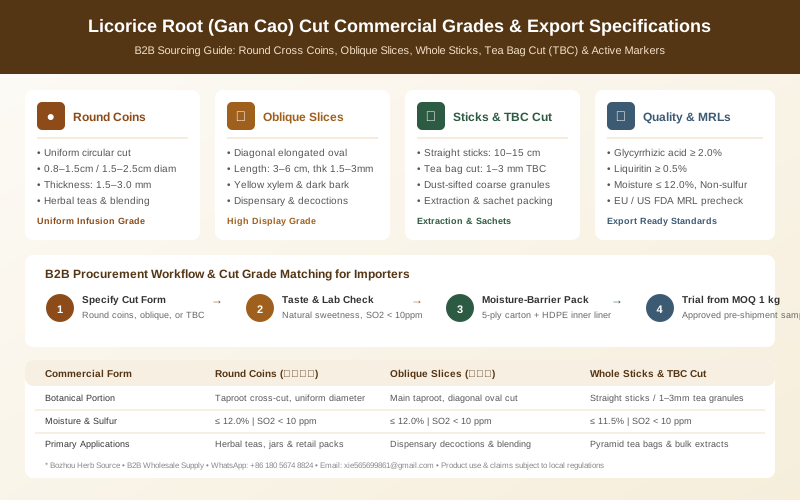
Bozhou Herb Source supplies bulk licorice root (Glycyrrhiza uralensis, Gan Cao, 甘草) as dried whole root, cut slices, sticks and custom processing forms for overseas B2B importers. Importers searching for licorice root cut wholesale should confirm cut style (Grade A large round coins 1.5–2.5 cm vs. standard coins 0.8–1.5 cm vs. oblique oval slices 1.5–3.0 mm vs. cut and sifted C/S 2–8 mm vs. tea bag cut TBC 1–3 mm), peeled vs. natural unpeeled form, root diameter/grade, natural sweetness, Glycyrrhizic acid (HPLC ≥ 2.0%) and Liquiritin (≥ 0.5%) active content expectations, sulfur-free clean dehydration (SO2 < 10 ppm), European Pharmacopoeia EP 2.8.13 compliance, moisture control (≤ 12.0%), and absence of mold or foreign matter before comparing quotations. MOQ from 1 kg is available for trial orders and mixed botanical raw material shipments. Send target specification, estimated quantity, destination country, packing and document requirements; product use, labeling and claims are subject to local regulations in the destination market. Approved sample reference photos are recommended for repeat-order consistency.
Licorice root cut forms and grade comparison for wholesale buyers
Glycyrrhiza uralensis root is processed into distinct commercial specifications for herbal tea blending, food-herb formulations, extraction and traditional decoction. Wholesale buyers comparing licorice root cut wholesale prices should clarify the cut form and diameter grade to ensure batch consistency.
Round cross-cut coins (圆形切片)
Uniform circular coin slices with consistent thickness (typically 1.5–3 mm) and selected diameter ranges: Grade A large round coins (1.5–2.5 cm diameter) and standard round coins (0.8–1.5 cm). Ideal for herbal tea blends, infusion bags and consumer packaging where visual uniformity and even infusion are paramount.
Oblique oval cut slices (斜切片)
Cut diagonally across the root body to showcase fiber texture, yellow xylem and dark outer bark ring. Favored by herbal dispensaries, decoction packs and bulk raw material distributors looking for prominent slice presentation.
Peeled vs natural unpeeled root (去皮与原皮)
Supplied as natural unpeeled licorice root (reddish-brown outer cork bark for traditional Asian formulas and decoctions) or machine-peeled licorice root (去皮甘草, outer bark stripped away to showcase bright yellow xylem, preferred by European and North American herbal tea blenders for reduced bitterness and pure sweetness).
Cut and Sifted (C/S 2–8 mm) & Tea Bag Cut (TBC 1–3 mm)
Cut and Sifted (C/S 2–8 mm / 4–10 mesh) coarse granules for loose-leaf blending, botanical tinctures and percolation extraction; machine-sifted Tea Bag Cut (TBC 1–3 mm with 20–60 mesh dedusting) calibrated for automated high-speed pyramid and paper tea bag packing without machine blinding.
Whole root sticks & cut cubes (整根甘草条 / 丁块)
Selected straight whole root segments (10–15 cm) for extraction and processing, or chopped cut cubes optimized for machine packaging and balanced botanical blending.
Sulfur-free clean dehydration & moisture control
100% clean modern dehydration (no coal fumes, non-sulfur fumigated, SO2 < 10 ppm) preserving natural sweetness and bright yellow interior, with strict moisture control (≤ 12.0%) preventing mold and sugar degradation during ocean freight.
Testing and pesticide residue control
Raw lots undergo testing for active markers (Glycyrrhizic acid ≥ 2.0%, Liquiritin ≥ 0.5%), heavy metals (lead, cadmium, arsenic, mercury), and multi-residue pesticide prechecks aligned with European Pharmacopoeia EP 2.8.13, EU Regulation (EC) No 396/2005 and US FDA tolerances with full COA support.
When comparing quotations, verify whether prices reflect sulfur-free natural drying, slice thickness uniformity, moisture content (typically ≤ 12%), fiber proportion, and natural sweetness without bitter aftertaste. Always request an approved sample reference before bulk shipment.
Bozhou licorice sourcing context
While primary cultivation of high-potency Glycyrrhiza uralensis centers in Inner Mongolia (Ordos and Hangjin regions) and Xinjiang, Bozhou in Anhui Province operates as China's premier herb distribution and processing center. Sourcing licorice root through Bozhou gives international buyers direct access to consolidated harvest lots, competitive grading facilities and mixed-botanical container shipments.
Origin and harvest timing
Licorice roots are harvested in autumn after 3 to 5 years of cultivation to ensure dense root texture and concentrated active compounds. Spring and autumn processing lots offer flexible availability across various diameter grades.
Sweetness and active compound profile
Natural sweetness and glycyrrhizic acid concentration depend on root maturity and growing region. We help buyers specify target taste, sensory profile and test requirements according to buyer product specifications.
Sample reference and trial orders
We provide approved sample reference lots with clear slice photos and diameter measurements before order confirmation. Importers can start with an MOQ from 1 kg for initial sensory, cut-size or extraction testing.
Export documentation support
We assist buyers with export documentation including Certificate of Analysis (COA), Certificate of Origin (COO), Phytosanitary Certificate, and destination-country testing support. Importers should confirm local regulations and food/supplement labeling rules.
Licorice root sourcing notes for importers
Overseas botanical buyers and herbal product manufacturers should verify target cut size, moisture limit, appearance, odor, and destination-country compliance before placing bulk orders.
Processing forms and inspection
Confirm whole root sticks, round cross-cut coins, oblique slices, or cut pieces. Inspect for reddish-brown to greyish-brown outer bark, distinct yellow interior, prominent fibrous texture, sweet taste, and absence of mold or foreign matter.
Packaging and freight options
Standard export packaging includes multi-layer craft cartons or woven bags with polyethylene moisture-barrier inner liners to preserve natural aroma and prevent moisture absorption during maritime transit.
Inquiry checklist and CTA
To request an accurate quotation, please share your desired cut form, estimated order quantity, target port/country, and required certifications. Product use, labeling and claims are subject to local regulations.
Request licorice root cut quoteGallery and visual reference
Published gallery images represent reviewed bulk dried slices and cut pieces for specification reference. Actual shipment lots are matched to written standards and approved pre-shipment sample references.
Licorice root sourcing FAQ
What details should importers confirm before ordering licorice root?
Confirm the slice thickness, sweetness profile, color, dryness, moisture, foreign matter, approved sample reference, packaging and document requirements, quantity and destination country before order confirmation.
Can licorice root samples or trial orders start with MOQ from 1 kg?
MOQ from 1 kg can be discussed for licorice root samples, root and rhizome trial quantities and mixed botanical raw material orders when market availability, packing and shipment planning are suitable.
What document topics should buyers discuss for licorice root?
Buyers can discuss COA, third-party testing, certificate of origin, phytosanitary documents, packing marks, label information and destination country requirements before shipment. Product use, labeling and claims are subject to local regulations.
What cut specifications and forms are available for licorice root wholesale?
Licorice root (Glycyrrhiza uralensis, Gan Cao, 甘草) is available across multiple standardized export specifications: round cross-cut coins, oblique cut slices, straight whole root sticks, and tea bag cut (TBC 1–3 mm). Commercial physical forms include Grade A large round coins (特级大圆片 1.5–2.5 cm diameter, 1.5–2.5 mm thickness, bright yellow xylem, dark red-brown cork bark, low broken crumb), standard round coins (标准圆片 0.8–1.5 cm diameter for herbal tea blending and infusion bags), selected oblique oval slices (斜切片 1.5–3.0 mm thickness showcasing radial fiber grain and golden xylem), whole root straight sticks (整根甘草条 10–20 cm length sorted by diameter), machine-sifted tea bag cut (TBC 1–3 mm with 20–60 mesh dedusting for pyramid tea bags and filter paper pouches), and fine botanical powder (80–120 mesh for extraction and beverage blends). Importers should specify cut form, diameter grade, glycyrrhizic acid expectations, moisture limit, sulfur-free drying, packaging style and destination country before quotation. Product use, labeling and claims are subject to local regulations.
Can overseas buyers order peeled vs natural unpeeled licorice root, and what are the functional differences?
Yes. Bozhou Herb Source supplies both natural unpeeled licorice root (with dark reddish-brown to brown outer cork bark, favored for traditional decoctions, Asian dietary formulas and rustic botanical displays) and machine-peeled licorice root (去皮甘草, with the fibrous outer cork bark stripped away to reveal uniform bright lemon-yellow xylem). Peeled licorice is widely preferred by European and North American herbal tea blenders and dietary supplement formulators seeking reduced earthy bitterness, pure rounded natural sweetness, and smooth mouthfeel. Both peeled and unpeeled grades can be supplied in round cross-cut coins, oblique slices, cut-and-sifted (C/S 2–8 mm), or fine tea bag cut (TBC 1–3 mm). Product use, labeling and claims are subject to local regulations.
What is the difference between Cut and Sifted (C/S 2–8 mm) and Tea Bag Cut (TBC 1–3 mm) licorice root?
Cut and Sifted (C/S, typically calibrated to 2–8 mm / 4–10 mesh) is designed for coarse loose-leaf herbal tea blending, botanical tinctures, fluid extracts, and craft brewing infusions where larger particle surface area and minimal dust allow free fluid flow without mesh compaction. In contrast, Tea Bag Cut (TBC 1–3 mm with 20–60 mesh dedusting) is micro-calibrated for automated high-speed ultrasonic pyramid sachets and single-chamber paper tea bags, ensuring rapid water infusion and zero packaging machine clogging. Both forms undergo multi-stage magnetic separation and air-sifting dedusting. Importers should specify C/S vs TBC particle size requirements before quotation. Product use, labeling and claims are subject to local regulations.
What quality control standards, active compound limits and sulfur-free drying apply to bulk licorice root export?
Export-grade licorice root batches undergo clean low-temperature heat-pump dehydration without sulfur fumigation (strictly sulfur-free, SO2 < 10 ppm compliant with EU Regulation EC 396/2005, US FDA and Japanese Pharmacopoeia limits), preserving the natural bright yellow xylem and intense natural sweetness. Moisture content is strictly controlled (≤ 12.0%) to prevent sugar degradation, stickiness, or mold during maritime freight. Quality testing includes Glycyrrhizic acid verification (HPLC ≥ 2.0% meeting pharmacopoeia standards), Liquiritin screening (HPLC ≥ 0.5%), heavy metals screening (lead, cadmium, arsenic, mercury), ochratoxin A and aflatoxin screening, and multi-residue pesticide prechecks aligned with European Pharmacopoeia EP 2.8.13 and destination-country standards with full COA support. Product use, labeling and claims are subject to local regulations.
What export packaging, moisture protection and document support are provided for licorice root wholesale shipments?
Standard bulk export packaging for licorice root wholesale consists of 20 kg or 25 kg heavy-duty multi-layer kraft paper bags or 5-ply corrugated export cartons with food-grade double polyethylene (PE) moisture-barrier inner liners to preserve natural sweetness and prevent humidity absorption during ocean transport. Full export documentation including Certificate of Analysis (COA), Certificate of Origin (COO), Phytosanitary Certificate, packing list and commercial invoice is arranged per shipment. Flexible trial orders and sample evaluation start with MOQ from 1 kg. Product use, labeling and claims are subject to local regulations in the buyer market.
Is licorice the same as liquorice, and which name should importers use?
Yes. Licorice root and liquorice root are the same botanical raw material (Glycyrrhiza uralensis, Gan Cao, 甘草). UK, Irish, Australian and some other Commonwealth buyers write liquorice root, while US buyers, pharmacopoeia entries and most export documents write licorice root or root of Glycyrrhiza; both spellings describe the same dried root and rhizome of Glycyrrhiza uralensis on lab reports, purchase orders, broker documents and customs paperwork. Importers can use either name as long as the specification sheet also lists the Chinese name 甘草, the pinyin Gan Cao and the Latin botanical name Glycyrrhiza uralensis together with the physical form, cut or mesh, glycyrrhizic acid expectation, moisture limit and lot number, so supplier, forwarder and customs all reference one material. Product use, labeling and claims are subject to local regulations.
Which licorice root forms and powder specifications are available for wholesale buyers?
Wholesale licorice root is quoted in several physical forms: whole root sticks, round cross-cut coins, oblique oval slices, peeled or natural unpeeled root, cut and sifted (C/S 2–8 mm), tea bag cut (TBC 1–3 mm) and licorice root powder. Licorice root powder is normally offered at 80–120 mesh for beverage blends, botanical extraction and further processing, and a coarser 40–60 mesh licorice root powder can be discussed when a buyer needs less dust or slower release in a blend. Importers should confirm the exact form, diameter grade or mesh, glycyrrhizic acid expectation, moisture limit, sulfur-free drying, packing style, estimated quantity and destination country before quotation; MOQ from 1 kg supports sample and trial evaluation of any form. Product use, labeling and claims are subject to local regulations.
Traditional Herbal Pairings & Formulation Synergies (传统经典搭配与配伍)
In traditional Chinese botanical formulation (药对), companion herbs are combined to enhance specific qualities, balance temperature, or improve tea infusion harmony. Here are classical pairings for Licorice Root:
Astragalus Root (黄芪)
Middle Qi tonification with natural sweetness and formula harmonization.
View Astragalus Root →Chrysanthemum Flower (菊花)
Dual soothing floral infusion for seasonal throat and body comfort.
View Chrysanthemum Flower →Dried Ginger (干姜)
Classical warming and digestive harmonizing pair for winter wellness teas.
View Dried Ginger →*Formulation note: Traditional pairings are provided for B2B tea blenders, functional beverage developers, and dietary formulators. Finished product ratios and claims depend on target market regulations.
Target Market Regulatory & Efficacy Positioning (对应国家合规功效宣传指南)
How international B2B buyers in major destination markets position and compliantly label Licorice Root according to local regulatory frameworks:
🇺🇸 North America (FDA / DSHEA / NHP)
Natural botanical sweetener, throat-soothing herbal teas, clean-label flavoring agent in dietary supplements.
🇪🇺 Europe & UK (EFSA / THMPD)
Classic European herbal infusion staple, traditional digestive comfort tea ingredient complying with EU botanical regulations.
🇯🇵🇰🇷 East Asia (Japan Kampo / Korea MFDS)
Essential Kampo (カンゾウ) & Hanbang (감초) harmonizing agent, throat lozenge and beverage formulation material.
🇸🇬🇲🇾 Southeast Asia (Halal & Food / Beverage)
Essential balancing herb in traditional herbal teas (凉茶) and refreshing cooling herbal drinks.
*Regulatory guidance: Product use, import classification, nutrition labeling, and allowable marketing claims are strictly subject to local food, drug, or dietary supplement laws in the destination country. Bozhou Herb Source provides raw botanical ingredients with COA, origin, and testing documentation upon request.
Related sourcing guides
Read these B2B sourcing guides for specification, sample, packing and document discussion before requesting a quote.
Licorice Root Wholesale: Forms, Grades and Packing
Importer guide for licorice root wholesale from China, including forms, cut sizes, grade comparison, sample confirmation and packing discussion.
Licorice Root Cut Wholesale: Importer Sourcing Guide for Gan Cao Slices, Forms and Specifications
A GEO-ready B2B sourcing guide to licorice root cut wholesale (Gan Cao, Glycyrrhiza uralensis), covering round coins, oblique slices, tea bag cut (TBC), sweetness markers, export documents, and MOQ from 1 kg.
Astragalus Root Wholesale Buying Guide
A B2B buying guide for astragalus root wholesale buyers, covering forms, specifications, grades, samples and sourcing from China.
Astragalus Root Cut Wholesale: Importer Sourcing Guide for Huang Qi Slices, Grades and Specifications
A GEO-ready B2B sourcing guide to astragalus root cut wholesale (Huang Qi, Astragalus membranaceus), covering oblique willow-leaf slices, round cross-cut coins, tea bag cut (TBC), astragaloside IV standards, export documents, and MOQ from 1 kg.